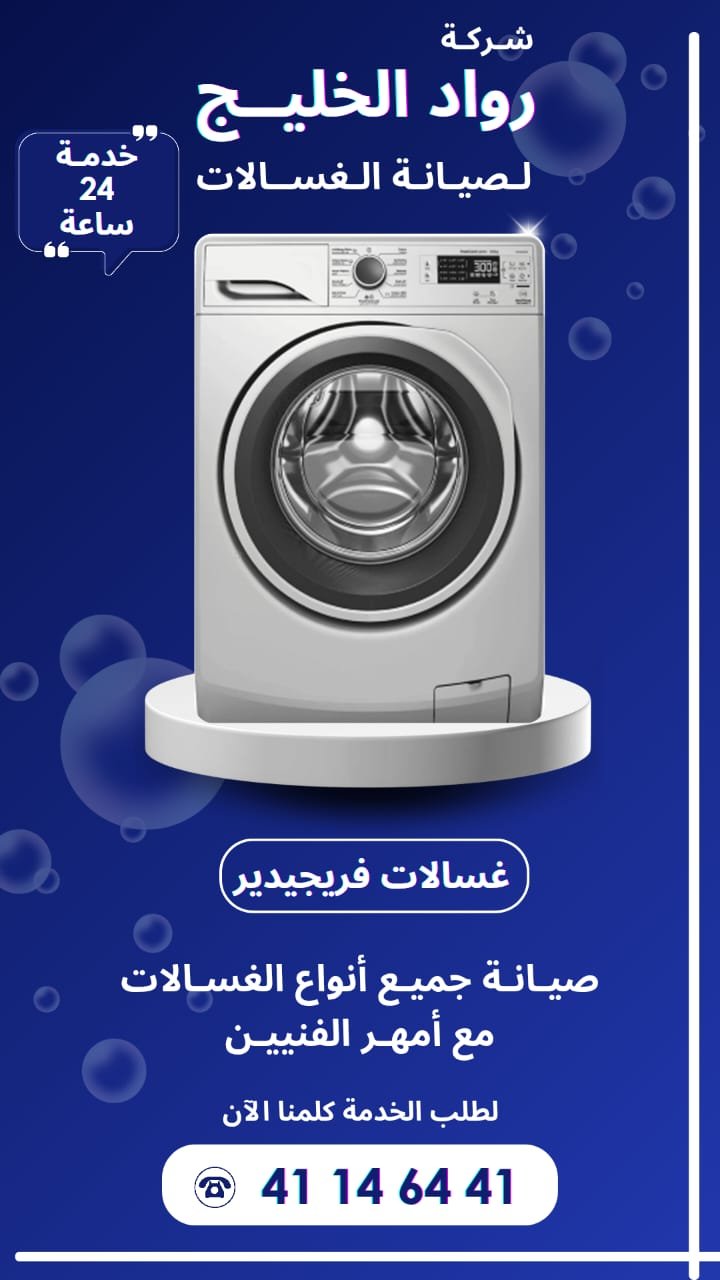
Automatic Washing Machine Repair in Jahra – 24-Hour Service
If your washing machine has started to wear out and keeps breaking down frequently, it’s definitely not a coincidence, especially if it's being used daily. Some malfunctions may appear minor, but their recurrence indicates a more serious fault that must be addressed quickly. In this article, we will cover the most common washing machine problems in Jahra and how to deal with them.
Malfunctions in Washing Machines with Heavy Household Use
Large households or those that use the washing machine intensively every day—like some families in Jahra—face different types of malfunctions compared to homes with moderate use. The automatic washing machine is designed for regular use, but if it is run more than once per day or consistently overloaded, mechanical and electronic issues begin to surface that wouldn’t typically appear under normal circumstances. This is when recurring problems begin to occur, which may eventually lead to damage to sensitive components like the motor or the board—or even require complete replacement of the machine if neglected. Heavy use is not a problem in itself, but it must be met with awareness in operation and smart periodic maintenance to prevent gradual deterioration of components.
Washing machines in heavily used households experience more strain on every internal component:
- The motor runs for longer periods
- The pump drains more water
- The sensors receive repeated commands
- The belt is under constant tension
Additionally, there is accumulation of dirt, foam, detergent residue, and lint inside the drum and pipes. The higher the daily load, the higher the likelihood of malfunctions occurring sooner than expected.
The most common malfunctions in washing machines used intensively include:
- Sudden stopping during the program due to overheating of the motor from excessive load
- Noticeable weakness in spinning despite the machine operating as if everything is normal
- Bad odors coming from the drum due to bacteria buildup caused by excess moisture
- Clogged filters or drainage pump due to repeated use without cleaning
- Belt tearing or slipping due to daily heavy loads
- Sensor damage from continuous use without rest between cycles
- Multiple error codes appearing on the display due to data reading disturbances
- Strong and annoying vibrations due to overloading or unbalanced clothing distribution
- Detergent drawer damage or clogging due to heavy use without cleaning
- Lime or dirt buildup in internal pipes due to unfiltered water
These malfunctions usually don’t appear suddenly but develop gradually and increase with every week of unregulated use. Unfortunately, many people, when faced with such problems, start by trying quick fixes like restarting the machine, light external cleaning, or even ignoring the noise or vibration. But the result is always that the malfunction worsens.
The best way to handle washing machines in high-use households is to establish a clear routine for periodic care—starting from cleaning the drawer and filter to conducting a monthly inspection of the drum and belt condition. It is also very important to use light or quick wash programs when the load is not heavy, because running heavy programs every time places unnecessary strain on the machine. Additionally, giving the washing machine a rest between cycles helps reduce thermal load on the motor and the board.
As for maintenance, it is recommended to conduct a preventive inspection every 4 to 6 months, especially in homes where the washing machine is operated more than 10 times per week. The inspection should include:
- Connections
- Pump condition
- Belt integrity
- Carbon brush level in the motor (if applicable)
- Cleaning of internal air and water vents
Section Summary:
Heavy use of washing machines in large homes in Jahra leads to frequent malfunctions including weak spinning, sudden stops, clogs, and internal part damage. The solution lies in user awareness, regular maintenance, and smart handling of programs and laundry loads.
Final Note:
If you use the washing machine more than once a day, don’t treat it as an indestructible device—it needs double the care just like any machine in a high-pressure environment. Ignoring minor malfunctions will eventually lead to major breakdowns.
Why Do Repair Costs Differ Between Technicians in Jahra?
One of the most common questions washing machine owners ask when their device breaks down is:
“Why did this technician ask for a higher amount than the other, even though it's the same issue?”
The difference in repair costs for washing machines in Jahra is due to many factors, and it's not always because of greed or manipulation. Sometimes, the more expensive technician is actually more committed, uses original spare parts, or has more experience. On the other hand, the cheaper one may work randomly or without any warranty.
That’s why it’s very important for the customer to understand what determines repair prices and how to compare offers smartly—without wasting money or risking their appliance.
The first thing to understand is that washing machine malfunctions are often interconnected. A fault that appears simple may actually be the result of a larger problem. A professional technician takes time during inspection, uses accurate diagnostic tools, and explains the issue and part costs in detail to the customer. A less experienced or quick technician might just replace a part without a full check, only to realize later that the problem hasn’t been solved—leading to extra charges.
Main reasons for price variation between technicians include:
- Type of spare parts used: Some use genuine parts with warranty, others use imitations or refurbished ones.
- Warranty duration: The longer the warranty on the service or part, the higher the price—because the technician guarantees their work.
- Nature of the fault: Some issues are simple, while others are complex and require full dismantling and electronic testing.
- Technician's experience: A highly experienced and reputable technician charges more for guaranteed quality.
- Emergency service: Off-hours or late-night service usually costs more.
- Inspection fees: Some include the visit in the final cost; others charge separately.
- Customer location: If the house is far or in a crowded area in Jahra, costs may rise due to transportation.
- Part availability: Rare or specially ordered parts naturally cost more.
- Authorized service centers vs. freelancers: Certified centers tend to charge more but offer clear invoices and warranties.
- Repair duration: Some fix it same-day, others take two or more days—this reflects in the price.
- Diagnostic equipment usage: Those who use advanced tools charge more for accurate inspection.
- After-sales service: Technicians who provide follow-up add real value that justifies the price.
- Professional handling: Technicians who explain faults and provide written reports or invoices follow a more professional standard with different pricing.
In many cases, the cheaper price is not always better, especially if the technician avoids giving a warranty or doesn't explain things clearly. Some clients later regret it when the same problem returns or they discover the part installed wasn’t genuine.
The fair price is the one that matches the service offered—transparent, guaranteed, and effective.
Tips to compare technicians:
- Ask what kind of parts will be used—original or generic.
- Request a written warranty on the service or part.
- Don't agree to repair before confirming an accurate diagnosis.
- Ask for a breakdown of all cost components: parts, labor, inspection.
- Check technician or center reviews online if available.
- Avoid extremely low offers—they usually come at the expense of quality.
- Only accept prices that include all costs, with no surprises later.
Section Summary:
Washing machine repair costs vary in Jahra depending on parts used, technician experience, fault complexity, warranty, and service center type. A higher price doesn't always mean a scam, and a lower price isn’t always a bargain. Balance between quality and cost is key.
Final Note:
Before agreeing to any repair cost, make sure you understand all details. Remember, cheap work can cost more later if the repair wasn’t done properly or parts weren’t guaranteed.
The Importance of Comprehensive Diagnosis Before Repair
One of the most common mistakes washing machine owners make is rushing into repairs without performing a full inspection of the device.
Some technicians focus only on the visible problem, such as the spin cycle not working or water not draining—while ignoring deeper issues that might be the root cause of the malfunction.
This is where the comprehensive diagnosis comes in—it's a crucial step before any serious repair.
Diagnosis is not just a routine—it’s a precise analysis of the machine’s entire condition, which helps reveal hidden problems and prevents other breakdowns after repair.
The difference between technicians becomes clear during this step.
A professional technician takes time to evaluate every part, tests various programs, listens for noises, observes washing behavior, checks the temperature sensor, water pressure, control panel response, drum rotation strength, and other indicators of the washer's performance.
This gives you confidence that the issue being fixed is truly the cause, and that it won’t return in a few weeks.
Neglecting diagnosis leads to:
- Fixing a surface-level problem while leaving the real issue unresolved
- The same issue coming back within days
- Other components breaking down due to the original cause not being treated
- Wasting time and money on repeated repairs
- Using the wrong parts due to misdiagnosis
- Unexpected breakdowns later
- Calling the technician multiple times for the same fault
- Longer downtime because hidden issues only emerge post-repair
- Not knowing whether the replaced part was actually faulty
- Warranty issues due to incorrect initial assessment
Some malfunctions are interconnected.
For example, a faulty temperature sensor might cause program interruptions or incorrect water levels.
Or a small drain valve issue could lead to water buildup and affect the spin cycle.
That’s why a smart technician doesn’t just focus on symptoms, but looks for causes, and inspects every related system.
Key steps of a comprehensive inspection include:
- Running the washing machine on multiple programs to observe all stages
- Carefully checking water input and output
- Ensuring proper sensor responses (door, temperature, water level)
- Measuring electrical consumption to detect abnormal loads
- Listening for odd noises during wash or spin
- Analyzing motor performance for delays or weakness
- Examining belt condition for wear or looseness
- Testing control panel functionality
- Inspecting the drain pump and its strength
- Checking hoses and internal connections
Comprehensive diagnosis takes time—but saves you from future repairs.
Some technicians offer it as part of the repair package; others charge a small extra fee—but what matters is that you request it and insist on it if you want to avoid recurring issues.
Section Summary:
A full inspection before repair is crucial for identifying the real faults and avoiding surface-level fixes. It enables proper decisions, correct parts usage, and effective long-term service.
Final Note:
If the washing machine isn’t fully diagnosed before repair, then any fix after that is a gamble.
Be cautious and insist on thorough checks—even if the issue seems simple at first glance.
Most Common Washing Machine Problems Related to Electronic Programs
Modern washing machines rely heavily on electronic programs.
This feature has improved performance and energy efficiency, but it has also introduced new types of malfunctions that weren’t common in older machines.
In areas like Jahra, many customers complain of strange issues—even though the mechanical parts seem to be working fine.
The reason is often a fault in the electronic board or smart system that controls every movement inside the washer.
These electronic programs are precise and sensitive.
Any small fault in them can affect the entire washing cycle.
One of the biggest challenges is that faults in electronic programs are not obvious like mechanical failures.
The washer might turn on—but not spin properly, or stop mid-wash, or repeat the same cycle multiple times.
This leaves customers confused—unsure whether the problem is with a sensor, the board, or the programming itself.
Such issues are complex and require a technician who understands electronic systems—not just someone who randomly swaps parts.
Common problems related to electronic programs include:
- The washer suddenly stopping mid-cycle without an obvious reason
- Error lights turning on or unknown codes appearing on the screen
- A wash cycle starting then suddenly restarting itself
- Programs taking longer than usual with no clear cause
- Only one program (like spin or quick wash) failing
- Buttons on the control panel not responding
- Too much or too little water entering despite the faucet being open
- The rinse cycle going on for too long
- The spin cycle refusing to work, even though the drum turns manually
- The washer restarting on its own without user input
Most of these issues are caused by faults in the control board or internal software programming.
Sometimes the reason is simple—like a sudden power outage that corrupts the settings, or moisture entering the board and causing a short circuit, or even dust on the connectors.
Unfortunately, many technicians lack specialized electronic diagnostic tools, so they just replace parts randomly—leading to costly repairs without solving the actual problem.
What to do if you face an issue related to programs:
- Unplug the machine from power for 10 minutes, then restart
- Check your power source for stability
- Note any codes or lights and tell your technician
- Stick to one program and test it, don’t switch between many
- Do not open or touch the board if you lack expertise
- If the issue persists, call a technician who specializes in electronics
- Check for any water leaks that may be reaching the board
- Avoid using unknown or mixed program settings
- Keep the control panel clean and dry
- Run the washer empty on a cycle to observe its behavior
Remember:
Fixing electronic program issues is different from fixing regular faults.
Programming may require updates or chip replacements, which need special devices.
Sometimes, the only solution is to replace the control board, which is expensive—but necessary if the machine is still worth repairing.
Section Summary:
Electronic program issues in washers include cycle interruptions, command failures, and slow responses. Handling them requires specialized technicians and precise diagnosis—before attempting any fix.
Final Note:
If your washer has a digital screen and smart programs, any sudden glitch should be treated as an electronic problem—not a mechanical one.
Don't ignore weird symbols or unexpected behavior—they’re usually early warnings of major faults.
Tips to Protect Clothes from Damage During Washing
Many people complain that the washing machine has started to "ruin" their clothes—that garments come out faded, have holes, or even shrink in size.
While they assume the issue is with the fabric or detergent, the real cause is usually in how they use the machine, the selected program, or overloading it.
Whether you use a basic or advanced automatic washing machine, there are essential practices you must follow to ensure your clothes come out clean and preserved—not damaged or worn out.
This point is especially important in Jahra, where large households and varied clothing types require awareness in how washing is done.
Most common causes of clothing damage are not from the washer itself but from how it’s used:
- Using the wrong program: Washing cotton with the delicate cycle causes excess rubbing and tangled fibers
- Overheated water: High temperatures fade colors and shrink delicate fabrics
- Overloading the washer: Clothes can’t move freely and experience more friction
- Mixing clothes of different types and colors: For example, washing jeans with chiffon causes instant damage to light fabrics
- Using a detergent that doesn't suit the fabric type: Some detergents are too harsh for delicate textiles
- Leaving clothes wet after washing: This leads to mold, bad odor, and sometimes color transfer
- Not cleaning the detergent drawer or filter: Residue can return to clothes and cause stains or pilling
- Skipping the rinse cycle: Soap left in fabric leads to fading and possible skin irritation
- Dirty washing drum: Bacteria and dirt transfer to clothes during each cycle
- Running high-speed spin cycles for every fabric type: Some materials can't handle high force and get damaged quickly
If you want to protect your clothes, here are simple steps to help preserve and extend their life:
- Sort clothes by fabric type (cotton, synthetic, delicate) and color (dark, light, white)
- Read washing instructions on each item before loading it
- Use special laundry bags for sensitive items like lingerie or lace
- Wash new clothes separately the first time to avoid color bleeding
- Select a program that suits the fabric type, not just the wash duration
- Use less detergent if the load is small or the washer is compact
- Remove clothes immediately after the cycle ends to prevent odor and mold
- Clean the drum every two weeks to reduce bacteria and residue
- Use fabric softener in the final cycle to protect fibers
- Avoid spinning delicate clothes at high speeds; use air drying instead
It's also recommended to use steam or extra rinse programs if your washer supports them.
These help eliminate bacteria and brighten colors without harsh rubbing.
If you notice any changes in the shape or texture of clothes after washing, review your washing steps to find the mistake.
Sometimes, just one wrong setting can ruin a brand-new item.
Section Summary:
Clothes get damaged in the washer mostly due to user error—like wrong settings, overloading, or poor sorting.
The solution lies in following simple, effective habits to keep fabrics soft and intact.
Final Note:
Don't leave it to luck. Your clothes deserve care just like your machine.
A healthy wash starts with knowing your fabric, choosing the right program, and regularly cleaning your washer.
When Should You Replace the Washing Machine Instead of Repairing It?
Many people prefer to repair their old washing machines rather than buy a new one, especially if the machine is from a reputable brand or they’re used to it.
But in certain situations, replacement becomes more cost-effective and wiser than ongoing repairs—particularly when breakdowns become frequent or when repair costs come close to the price of a new unit.
In Jahra, some homes use washing machines heavily, and sometimes the appliance reaches a stage where repairs no longer help, no matter how skilled the technician is.
Deciding between repair and replacement requires awareness and a cost-benefit comparison.
Not every fault means the machine is done for, but if multiple systems start failing—like the motor, board, and pump all at once—it’s time to rethink.
Key signs that it's time to replace your washing machine:
- The machine is over 10 years old: Old models consume more power, and spare parts may no longer be available
- Repair cost is close to 50% of a new washer: If the quote is high, it might be smarter to invest in a new device
- Frequent breakdowns in short periods: Needing repairs every couple of months is a clear red flag
- Excessive noise or unusual vibrations: This could mean the internal frame is worn or damaged
- Chronic bad odors, even after cleaning: This suggests deeper issues with the drum or drainage
- Weak washing performance, even after servicing: Clothes don’t come out clean anymore
- Difficulty sourcing parts, or no availability from authorized dealers
- High electricity or water bills: Older machines consume more resources
- Repeated failure of the same part (e.g., pump or belt): Indicates an unresolved root problem
- Lack of compatibility with modern wash features: Like steam or quick wash modes
Other considerations:
- Do you have enough space for a new (same-size or larger) machine?
- Are there current promotions in Jahra for new appliances?
- Do you need a washer with extra features like drying or Wi-Fi control?
- Does the service center offer trade-in discounts for turning in your old machine?
- Has the technician given a professional, final opinion on your current machine’s condition?
If you decide to replace, follow these steps:
- Assess your usage needs: Do you need a large-capacity washer for a family? Or a compact, economical one?
- Compare brands based on warranty and local service support in Jahra
- Ask your technician about brands he trusts based on experience
- Choose a model with high energy efficiency to save power in the long run
- Keep the old washer temporarily to reuse parts if needed
Section Summary:
Replacing the washer is better than repairing it when the machine is old, breakdowns are frequent, and costs are high.
The decision should factor in expenses, performance, and the right time to upgrade.
Final Note:
If every repair is temporary and the washer never regains its original performance,
then it’s best to replace it before it damages clothes or increases your electricity bills unnecessarily.
Conclusion
A washing machine is an essential part of every home, and any malfunction causes major disruption—especially for daily use.
Whether the issue is simple or complex, the most important thing is to address it quickly and consult certified technicians when needed.
Proper diagnosis, smart usage, and regular maintenance will protect your appliance and extend its life.
And if your machine reaches a point where repairs no longer help, upgrading to a modern, efficient model is the smart move.
Frequently Asked Questions (FAQs)
Why do washer problems keep coming back after repairs?
Usually due to a lack of full inspection or fixing one part while ignoring the root cause. Accurate diagnosis is key.
Do washer programs need software updates?
Some modern machines allow updates via technicians, while others require full board replacement.
What’s the average lifespan of an automatic washer?
Around 8–12 years depending on use and maintenance. It may be less if overloaded or poorly maintained.
How can I tell if a spare part is original?
Check the part number, packaging, and manufacturer’s stamp. Always buy from authorized dealers for quality assurance.
Is it wise to fix a very old washer?
If faults are excessive and costs are high, replacing the unit is usually the better option.
Keywords
- Washing Machine Repair Jahra
- Automatic Washer Technician
- Jahra Service Center
- Frequent Use Washer Issues
- Full Washer Inspection
- Electronic Washer Programs
- Clothes Damage in Washer
- Replacing Old Washing Machines
- Washer Repair Costs
- Maintenance Price Differences
- Washing Program Errors
- Certified Washer Technicians
- Clothes Not Clean After Wash
- Washer Protection Tips
- Old Washer Service
- Smart Washer Usage
- Repeating Washer Faults
- Washer Electronic Servicing